It has been fairly well established that modern tennis is a game of short rallies. Rallies shorter than 4 shots – i.e. serve, return, one additional shot in the court by the server, and one additional shot in the court by the returner – account for about 70% of all rallies in a match. About 20% of the points then tend to fall into the 5-8 range, and only about 10% of the points will be the extended rallies we see in the highlight reels.
With that being said, I wanted to tackle the following two questions:
Are the rally length distributions similar regardless of whether the point started with a first serve or a second serve? In other words, are points that start with a second serve longer? And if so, longer by how many strokes?
Knowing that the first serve winning percentages can climb upwards of 80%, while the second serve winning percentages hover around 50%, how exactly do returners make up that 30%? Specifically, do the returners tend to win their points off of second serve returns in short rallies, quickly following the return? Or are they winning extended baseline battles?
To answer those questions, I looked at the 2020 US Open men’s singles point-by-point statistics, collected by Jeff Sackmann. The dataset contains 27,395 individual points tagged with features such as rally length, serve direction, or distance covered by both players, and can be found here. (If you want to see the code for the analysis below, click here).
Below are the rally lengths broken up by whether the point began with a first or a second serve. Note that I’m ignoring rallies of length 0 – double faults.
Rally Length Following a First Serve (2020 US Open Men’s Singles)
Rally Length Following a Second Serve (2020 US Open Men’s Singles)
Three things immediately stand out:
Both graphs are significantly right-skewed, confirming the prevalence of the 0-4 rally length on both first and second serve points. Overall, there just weren’t that many rallies longer than 5 strokes, regardless of what serve was put in play.
However, looking within the 0-4 range itself, there is a difference. In the first serve graph, we see two spikes at rally lengths 1 and 3; intuitively that makes sense – both 1 and 3 stroke rallies are points for the server. In particular, a rally length of 1 is either and ace or an unreturned serve, while rally length of 3 is a “Serve + 1” pattern by the server, where the “+1” results in either a winner, or an error by the returner.
Looking at the 0-4 range in the second serve graph, we see a smaller contribution of the 1 stroke rally – i.e. second serves get returned more often than first serves – but the key here is the spike in the rally of length 2. A rally of length 2 is a point for the returner – serve in play, followed by either a return winner, or an error by the server on shot number 3. Also, we have further confirmation of the importance of the “Serve +1” patterns for the server, with the rally of length 3 being the most common following a second serve in play.
Here is a table outlining some of the same data:
Serve in Play
Rally Length (Mode)
Rally Length 25th Percentile
Rally Length Median
Rally Length 75th Percentile
0-4 Rallies
5-8 Rallies
9+ Rallies
1st
1
1.0
2.0
3.0
88.25%
7.83%
3.92%
2nd
3
2.0
3.0
4.0
81.66%
11.08%
7.26%
Were second serve rallies longer at the 2020 US Open? Yes, but with a caveat. The mode, 25th, 50th, and 75th percentile values were all higher for the second serve points. We also see a bigger proportion of the rallies going past 5 strokes on the second serve. With that being said, over 80% of second serve points were still contested in that 0-4 range. Interestingly enough, the decrease of about 6.5% in the 0-4 point length between the first and second serve points is about evenly distributed among the 5-8 and 9+ rally lengths; both increased in the neighborhood of about 3.2%.
Now that we know the answer to the question of “are second serve rallies longer” is “yes, but..,” let’s take a look at where points won on the return come from. To do that, we need to look at “even” rally lengths: remember that rallies of length 2, 4, 6 etc. all indicate a point won by the returner. Comparing the frequencies with which rallies of a given length occur on first or second serves will give us insight as to where the returners do most of their damage.
Serve / Rally Length
2
4
6
8
1st
16.67%
6.86%
1.84%
0.97%
2nd
26.68%
9.62%
2.91%
1.69%
Difference
+10.01%
+2.76%
+1.07%
+0.72%
Looking at the table above, it is clear that the rally length of 2 – i.e. serve in play, followed by a return winner, or an error by the server on stroke 3 – was the biggest difference maker for the returners. About 26.7% of all points that started with a second serve were of length 2, as opposed to only 16.7% of points that started with a first serve. This difference of 10% drops off dramatically once the rally gets to 4 strokes and longer, meaning the effect of the serve and return diminishes pretty quickly after the third and fourth stroke of the rally.
I always wondered whether the players with high second serve return win percentages were good returners, or simply good baseliners, who put the return in play and grind out long rallies. This data suggests the former: good second serve return win percentage will probably be driven by strong performance in the 2 and 4 length rallies, highlighting the effect of the return itself.
A simple takeaway from this exercise is as follows: as you sit down to watch the Australian Open in the next few weeks, you have two options. If you want to see tennis for what it is and watch the whole matches, it will be a lot of serving and returning and not much else most of the time. If, on the other hand, you are a rally aficionado, I would just wait for the highlights.
One of the reasons I love tennis is because of players like Diego Schwartzman. The outliers. The ones, who are “not supposed to be there.” As of January 4th, 2021, Schwartzman is ranked #9 in the world, despite:
Being listed at 5’7,” while all the other players in the top 10 are 6’1″ or taller
Not having a high profile as a junior – his career high ITF World Junior Ranking was #217 – while most of the other players in the top 10 were ranked #100 or better
Holding serve less than 80% of the time, while the other players in the top 10 are comfortably over that mark
It’s this last bullet point that will have to change, if Schwartzman is to keep ascending up the ATP rankings: he will have to develop his serve into more of a weapon. He already excels on the return: according to the ATP Stats Leaderboards, he was the 2nd best returner on the tour in the year 2020. Yet when looking at the serve leaderboards, he ranked 48th. With that being said, let’s take a deeper dive into some of Schwartzman’s serve metrics to see where the improvements could come from.
First, this is how Schwartzman’s serve statistics compare to the rest of the top 10. The rankings are as of January 4th, 2021, and all statistics are for the year 2020.
ATP Rank
Name
First Serve %
First Serve Win %
Second Serve Win %
% of Service Games Held
1
N. Djokovic
64.4%
75.2%
54.1%
86.3%
2
R. Nadal
64.4%
73.6%
58.6%
87.1%
3
D. Thiem
63.0%
73.8%
51.7%
83.7%
4
D. Medvedev
59.1%
76.8%
53.6%
83.4%
5
R. Federer
66.0%
74.2%
53.0%
86.1%
6
S. Tsitsipas
64.5%
76.1%
57.8%
88.4%
7
A. Zverev
68.0%
76.7%
45.9%
82.5%
8
A. Rublev
59.0%
78.6%
53.4%
85.2%
10
M. Berrettini
62.1%
80.2%
58.0%
91.0%
Mean (no Schwartzman)
63.4%
76.1%
54.0%
86.0%
9
D. Schwartzman
62.7%
64.7%
50.9%
72.9%
Data Courtesy of ATPTour.com
Looking at the columns individually, the first serve percentage is right in line with the rest of the top 10 – there is no need for Schwartzman to get more first serves in play. Similarly, the second serve win percentage is not an outlier either. Schwartzman is about 3% below the rest of the top 10, but his second serve win percentage is better than Zverev’s, and close to Thiem’s, for example.
The reason why Schwartzman holds serve only about 73% of the time, while the rest of the top 10 is at 86%, is that Schwartzman gets way less out of his first serve. And since the majority of points in tennis are played following a first serve – you will rarely see a player with a first serve percentage below 50% – it follows that the low first serve win percentage is the driver behind Schwartzman holding serve less often than the other players in the top 10. The data bears that out – the closest player to Schwartzman’s 64.7% first serve win percentage is Rafael Nadal at 73.6% – about 9% higher.
Knowing that the key to holding serve more often will come from getting more out of the first serve, let’s look at Schwartzman’s first serve patters from 2020 and see if something stands out.
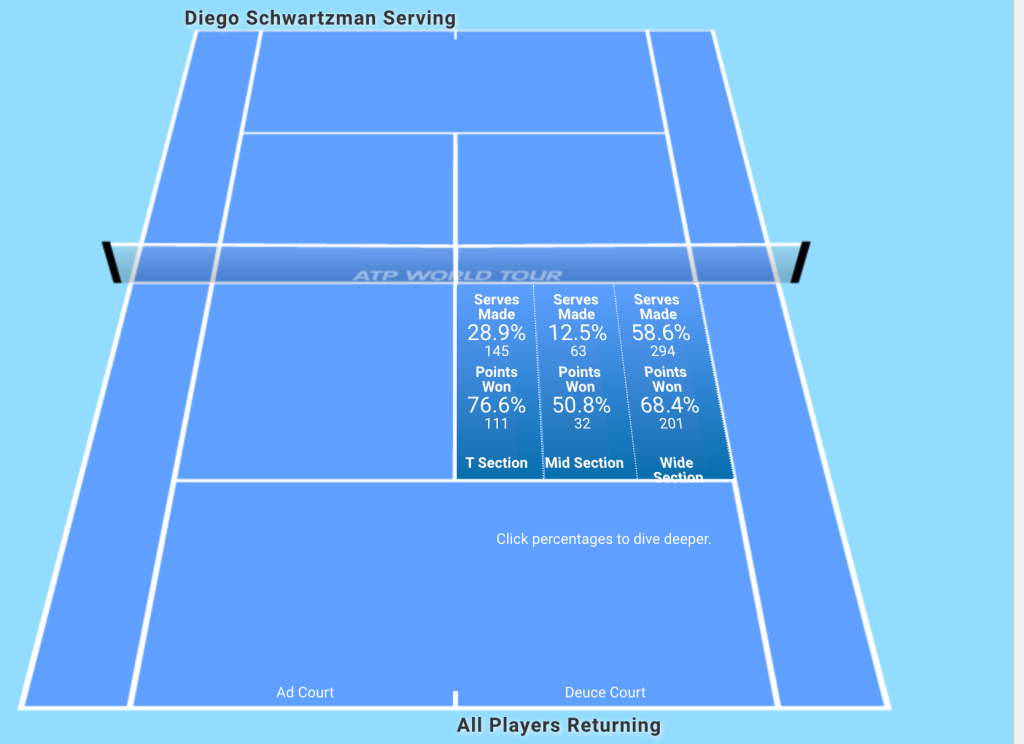
This is Schwartzman serving from the deuce side in 2020:
Below is the same data in a table. I have added a column “Free Point %,” which is just the number of aces and unreturned first serves divided by the total number of first serves hit into that particular part of the box.
Section
Deuce Wide
Deuce Mid
Deuce T
Serves Made
58.6%
12.5%
28.9%
Points Won
68.4%
50.8%
76.6%
Avg 1st Serve Speed
100 mph
101 mph
108 mph
Free Point %
26.2%
5%
31.8%
Data Courtesy of ATPTour.com
Looking at this table, the first adjustment I would try to make is to hit more first serves down the T in the deuce side of the court. It has been Schwartzman’s best first serve – hit at the highest velocity, with the highest overall winning percentage, and the highest free point percentage. Yet Schwartzman aimed that way less than 3 out of 10 times.
Let’s look at the same data for the ad side of the court:
Section
Ad Wide
Ad Mid
Ad T
Serves Made
31.2%
9.0%
59.8%
Points Won
65.9%
69.2%
59.5%
Avg 1st Serve Speed
103 mph
100 mph
104 mph
Free Point %
22.7%
21.9%
19.4%
Data Courtesy of ATPTour.com
In the ad side of the court, Schwartzman’s favorite serve was the T serve – to a right handed player’s forehand – and he hit that serve about 6 out of 10 times. Yet he had a higher winning percentage, and a higher free point percentage, going out wide. The difference in the ad side is smaller than it was in the deuce side, but it is something worth tracking and paying attention to.
Being one of the 10 best tennis players in the world is an impressive feat in and of itself. Yet if Schwartzman has his eyes set even higher, he will have to find a way to get more help from his first serve. A possible tweak – requiring no technical changes, or getting physically stronger – would be to aim more first serves down the T in the deuce, and out wide in the ad. Of course, it is not as simple as “prescribing” a player a certain serving pattern; the player has to be comfortable with the serve, and trust it in various match situations. But tennis is a game of adjustments, and this one might make holding serve a little easier for Mr. Schwartzman.
As of December 31st, 2020, the average age in the ATP top 20 was 28.7. Roughly half of the players – 9 to be exact – have celebrated their 30th birthday; Roger Federer, Rafael Nadal, Stan Wawrinka, Gael Monfils, and others, have been mainstays in the second weeks of Grand Slams for over a decade. But how did these elite players get to the top of our sport in the first place? Specifically, how highly ranked were they as juniors? And after turning pro, how old were they when they first ranked inside the ATP top 100? How about the top 50, and finally top 20?
To do that, I have decided to look at the 20 highest ranked players in the final rankings for the years 2016 – 2020. During that period, 38 individual players have finished the year inside the top 20 in any given year. (Note that someone like, say, Felix Auger-Aliassime is not included in the dataset; while has has already been ranked inside the top 20, he hasn’t finished the year ranked as high just yet).
The raw data is presented below. While the column names are self-explanatory, I have decided to split the individual ages for a bit more granularity. For example, let’s say a particular player’s birthday is in May, and he cracks the top 100 in August of the year he turns 20. His value in the table would have been 20.25, indicating 20 years old “an a quarter.” This was done to differentiate players who achieve a certain milestone, let’s say, the day after their 19th birthday, as opposed to someone who achieves that same milestone at age 19 and 10 months. The players are listed in alphabetical order by last name.
2016 – 2020 EOY ATP Top 20
Name
Career High ITF Junior Ranking
ATP Top 100 Break Age
ATP Top 50 Break Age
ATP Top 20 Break Age
Anderson
28
22
24.75
27.25
Bautista Agut
47
24.25
25.25
26.25
Berdych
6
18.5
19
20.75
Berrettini
52
22
22.75
23.25
Carreno Busta
6
22
23.25
25.75
Cecchinato
100
22.75
25.75
26
Cilic
1
19
19.25
20.25
Coric
1
18
18.5
21.75
De Minaur
2
19.25
19.5
20.75
Del Potro
3
18
19
20
Dimitrov
1
19.75
21.5
22.75
Djokovic
24
18.25
19
19.25
Edmund
8
20.5
21.75
23.25
Federer
1
18
18.5
19.5
Fognini
8
20.5
24
26.25
Gasquet
1
17.25
19
19
Goffin
10
21.5
21.75
24.25
Isner
93
22.75
24.5
24.75
Karlovic
N/A
24.5
27.25
29
Khachanov
16
20
20.75
22.5
Kyrgios
1
19.25
19.75
21
Medvedev
13
20.75
21.5
22.75
Monfils
1
18.75
19
22
Murray
2
18.5
18.75
19.25
Nadal
145
16.75
17.25
18.75
Nishikori
7
18.25
21.25
22
Pouille
23
21.25
22.25
22.5
Querrey
10
19.25
19.75
22.75
Raonic
35
20
20.25
21.75
Rublev
1
19.75
20
22.25
Schwartzman
217
21.75
24.5
25.5
Shapovalov
2
18.25
18.5
20
Sock
22
20.75
22
24.25
Thiem
2
20.5
20.75
22
Tsitsipas
1
19.25
19.5
20
Tsonga
2
22.25
22.5
22.75
Wawrinka
7
20
20.75
23.25
Zverev
1
18
19
19.5
Mean
20.05
21.11
22.49
Median
19.875
20.75
22.375
Min
16.75
17.25
18.75
Max
24.5
27.25
29
There are three general takeaways from looking at the group as a whole:
High junior ranking Out of the 38 players in the sample, 35 have been ranked inside the top 100 world junior rankings during the early stages of their tennis careers. The only exceptions are Ivo Karlovic, Diego Schwartzman, and Rafael Nadal. However, Rafael Nadal was already ranked inside the top 50 ATP by the time he turned 18 years old.
Moreover, 10 of the 38 players have been ranked #1 in the world as a junior, with 14 additional players having been ranked inside the top 10. That’s 24 out of the 38, or about 63% ranked higher that #10 ITF. A better than a top 100 junior ranking looks almost like a prerequisite to eventually make the ATP top 20, i.e these players have shown their potential in the junior ranks already.
Quick ascent into top 100 With most of these players having been elite juniors, they broke into the ATP top 100, on average, at around 20 years old. In other words, they tend to spend only about two years competing in the smaller tournaments on the Futures and Challenger circuits. Rafael Nadal was the youngest one in the sample, at less than 17 years old, while the oldest was Ivo Karlovic at over 24 years of age.
Slower ascent into top 20 As these players cracked the top 100 at around the age of 20, they first got into the top 50 roughly a year later, around the age of 21. The last thirty spots, into the top 20, then took about another year and a half, and the average age of cracking the top 20 was about 22.5. Once a player establishes himself in the top 20, he gets every opportunity – baring injury – to stay there, by being seeded at every tournament he plays and evading fellow top 20 players until the later rounds of a tournament. That is the main reason why the average age of the top 20 players in the world is significantly higher than the average age of the players breaking in for the first time: over the past five years at least, the players who make it into the top 20 tend to stay there.
While general observations are certainly useful, let’s see if we can learn some additional information by splitting the group of 38 players further. I have decided to do the split according to the highest achieved ITF junior ranking, and came up with the following three groups:
Players, who have achieved the #1 world ranking as juniors (10 players)
Players, who were ranked between #2 – #10 in the world as juniors (14 players)
Everyone else (14 players)
#1 ITF
Name
Career High ITF Junior Ranking
ATP Top 100 Break Age
ATP Top 50 Break Age
ATP Top 20 Break Age
Cilic
1
19
19.25
20.25
Coric
1
18
18.5
21.75
Dimitrov
1
19.75
21.5
22.75
Federer
1
18
18.5
19.5
Gasquet
1
17.25
19
19
Kyrgios
1
19.25
19.75
21
Monfils
1
18.75
19
22
Rublev
1
19.75
20
22.25
Tsitsipas
1
19.25
19.5
20
Zverev
1
18
19
19.5
Mean
18.7
19.4
20.8
Median
18.875
19.125
20.625
Min
17.25
18.5
19
Max
19.75
21.5
22.75
Not only has everyone on this list been ranked #1 ITF; every player on this list has won a junior Grand Slam title as well. In other words, these players would be everyone’s first choice in predicting the future stars of men’s tennis.
The #1 ranked juniors broke into the top 100 a year earlier than the whole group – 18.7 as opposed to 20.05. In fact, these guys tended to break into the top 50 by the time the rest of the group broke into the top 100. Interestingly enough, the pattern of a slower ascent into the top 20 holds for these players too: on average, it took them roughly 8 months (0.7 years) to make the jump from top 100 to top 50, but then another 17 months (1.4 years) to progress from top 50 to top 20.
If I was going to pick an upcoming member of this group, it would be the young Italian Lorenzo Musetti. Musetti has been ranked #1 ITF, he has won the 2019 Australian Open juniors crown, is currently ranked #129 ATP and doesn’t turn 19 until March 2021.
#2 – #10 ITF
Name
Career High ITF Junior Ranking
ATP Top 100 Break Age
ATP Top 50 Break Age
ATP Top 20 Break Age
Berdych
6
18.5
19
20.75
Carreno Busta
6
22
23.25
25.75
De Minaur
2
19.25
19.5
20.75
Del Potro
3
18
19
20
Edmund
8
20.5
21.75
23.25
Fognini
8
20.5
24
26.25
Goffin
10
21.5
21.75
24.25
Murray
2
18.5
18.75
19.25
Nishikori
7
18.25
21.25
22
Querrey
10
19.25
19.75
22.75
Shapovalov
2
18.25
18.5
20
Thiem
2
20.5
20.75
22
Tsonga
2
22.25
22.5
22.75
Wawrinka
7
20
20.75
23.25
Mean
19.80
20.75
22.36
Median
19.625
20.75
22.375
Min
18
18.5
19.25
Max
22.25
23.25
26.25
This group most closely follows the pattern of the whole sample, i.e. top 100 right around 20, top 50 around 21, and top 20 around 22.5 years old. On the other hand, there is a lot of variability within the group itself. We have players like Andy Murray, who have made it to the top 20 before their 20th birthday, while we also have someone like Fabio Fognini, who didn’t achieve that ranking until after he was 26 years old.
I want to point out two differences between this group, and the group of players who have achieved the #1 junior ranking. First, the #1 group, on average, made the jump into the ATP top 100 a full year younger than the #2 – #10 group. Also, while it took the #1 group less than a year to crack the top 50 after first making it to the top 100, it took the #2 – #10 group almost a full year. Admittedly, the sample size is not very big, yet the ascent up the professional ranks seemed to slow down a little bit for the #2 – #10 group.
My pick for the next member of this group is Thiago Seyboth Wild from Brazil. Thiago is currently ranked #117 ATP, was ranked as high as #8 in the world as a junior, and he will turn 21 in March of 2021.
Outside Top 10 ITF
Name
Career High ITF Junior Ranking
ATP Top 100 Break Age
ATP Top 50 Break Age
ATP Top 20 Break Age
Anderson
28
22
24.75
27.25
Bautista Agut
47
24.25
25.25
26.25
Berrettini
52
22
22.75
23.25
Cecchinato
100
22.75
25.75
26
Djokovic
24
18.25
19
19.25
Isner
93
22.75
24.5
24.75
Karlovic
N/A
24.5
27.25
29
Khachanov
16
20
20.75
22.5
Medvedev
13
20.75
21.5
22.75
Nadal
145
16.75
17.25
18.75
Pouille
23
21.25
22.25
22.5
Raonic
35
20
20.25
21.75
Schwartzman
217
21.75
24.5
25.5
Sock
22
20.75
22
24.25
Mean
21.27
22.70
23.84
Mean (no Nadal)
21.62
23.12
24.23
Median
21.5
22.5
23.75
Median (no Nadal)
21.75
22.75
24.25
Min
16.75
17.25
18.75
Min (no Nadal)
18.25
19
19.25
Max
24.5
27.25
29
This is the most varied group of the set. It includes players, who went to play NCAA Division 1 tennis after their junior careers, in John Isner and Kevin Anderson. It includes two of the best players of all time in Novak Djokovic and Rafael Nadal. It also includes Ivo Karlovic and Diego Schwartzman – really as polar opposites as you can get in terms of physical stature, as well as game style.
I have decided to calculate the statistics twice for this group: once with Rafael Nadal, and once without him. As he often is in tennis, Nadal is an extreme outlier, and could skew the data a little bit. I think that the statistics without Nadal are a little more informative.
Without Rafael Nadal, players in this group tended to break into the top 100, on average, after their 21st birthday, and into the top 20 around the age of 24. Compared to the #1 ranked juniors, their developments took roughly three years longer in both instances. Compared to the #2 – #10 group, their rankings progression was roughly two years slower.
I would guess that the main reason for this is – apart from the quality of the players – that players ranked outside of the top 10 ITF are less attractive for sponsors and agents, and are often not afforded the luxury of multiple wild cards into main draws of challengers or ATP tournaments. These guys have to earn their ranking “the hard way,” working their way through qualifying events at the Futures and Challenger levels. It takes a certain level of physical and mental maturity to be able to win multiple matches in a qualifying draw before even being afforded the opportunity to compete for ATP points in the main draw of a tournament. Junior and professional tennis are really two different worlds, and the adjustment to the pro game takes some time for the vast majority of players.
Takeaways
While I don’t think we can make sweeping generalizations based on this data alone, I think it contains some nuggets that we can keep in mind when looking for the next big star.
If you’re a young player, and your goal is to be in the top 20 in the world as a professional, a necessary first step is to achieve a top 100 junior ranking as a bare minimum; top 10 is really what you should be shooting for.
If you’re a tennis federation with a junior player ranked between #10 – #100 in the world, understand that he might not crack the top 100 for four or five years after his junior career is over. In other words, be prepared to support him for longer than one or two years, if you really believe in the player’s potential. Otherwise you run the risk of giving up too quickly.
Similarly, if you’re a parent of a player ranked between #10 – #100 ITF, and have the financial means to support your son for a year and then “see how it goes,” understand that your son is not likely to be in the top 100 after one year of professional tennis. It will be a longer process.
Finally, if you’re a fan and want to know the “next big thing” before the rest of your friends do, then pick a player, who has been recently ranked #1 in the world as a junior, and won a junior Grand Slam title. In about a year, your friends might be impressed.
There is a saying in tennis that you are only as good as your second serve. We can see the validity of that statement across all levels of the sport. Go to your local park, and you’re likely to see aggressive swings on the first serve, followed by a tentative tap on the second serve. At the highest level of the sport, the second serve becomes the battleground where the all-valuable breaks of serve get decided.
One component of an effective second serve is its velocity. All else being equal, a faster second serve will be more effective: it gets to the opponent faster, giving him/her less time to react, and hit a good return. Using data from the 2020 Nitto ATP Finals, I’d like to highlight a possible area of improvement for two of the young starts of our game: Alexander Zverev and Andrey Rublev.
Alexander Zverev is still only 23 years old, yet he has already been ranked as high as #3 in the world, and came tantalizingly close to winning his first Grand Slam title at the 2020 US Open. Andrey Rublev is also just 23 years old, and recently broke into the top ten of the ATP rankings for the first time. Both of them have (hopefully) more than a decade of high level tennis ahead of them, and plenty of time to add to their game. I would argue that being more aggressive on their second serves could help them close the gap on their competitors.
First, let’s look at how aggressive – in terms of comparing their second serve velocities to their first serve velocities – the two of them were at the 2020 Nitto ATP Finals. In each of the tables below, the first two columns highlight the average first serve and second serve velocities in their matches in London. The third column is just the average second serve velocity subtracted from the average first serve velocity. And the fourth column is the difference in km/h divided by the average first serve speed.
Let’s look at Alexander Zverev’ table for an example. In his group stage match against Diego Schwartzman, he hit his first serve with an average speed of 215.3 km/h, while hitting his second serve with an average speed of 150.1 km/h. That means, on average, Zverev’s second serve was about 30% slower than his first serve in that particular match.
Alexander Zverev
Match
Average 1st Serve Speed (km/h)
Average 2nd Serve Speed (km/h)
Difference (km/h)
Difference (percentage)
Schwartzman (Group)
215.3
150.1
65.2
30.28%
Medvedev (Group)
209.0
151.3
57.7
27.61%
Djokovic (Group)
210.3
158.2
52.1
24.77%
Data courtesy of ATPTour.com
Andrey Rublev
Match
Average 1st Serve Speed (km/h)
Average 2nd Serve Speed (km/h)
Difference (km/h)
Difference (percentage)
Tsitsipas (Group)
197.0
144.4
52.6
26.70%
Thiem (Group)
198.4
147.1
51.3
25.86%
Nadal (Group)
192.4
150.5
41.9
21.78%
Data courtesy of ATPTour.com
Two things immediately stand out. First of all, both Zverev and Rublev generate outstanding velocities on their first serves. For the three matches he played in London, Zverev was sitting (!) at around 210 km/h with his first serve. Yet both of them hit their second serves roughly 50 km/h slower than their first serves, with the lone exception being Rublev’s match against Nadal. In that particular match, part of the reason for the smaller difference was Rublev’s decrease in his average first serve velocity by about 5 km/h. Without looking at the data, I would guess that Rublev hit more slice first serves to target the Nadal backhand return in both deuce and ad sides of the court; the slice serve tends to be hit slower than the typical flat first serve.
Knowing that Rublev and Zverev lost in the ballpark of 25% of their velocity on their second serves in the majority of their matches, let’s compare them to the four players, who have made it out of the group stage in London.
Dominic Thiem
Match
Average 1st Serve Speed (km/h)
Average 2nd Serve Speed (km/h)
Difference (km/h)
Difference (percentage)
Tsitsipas (Group)
192.3
163.7
28.6
14.87%
Rublev (Group)
193.6
166.9
26.7
13.79%
Nadal (Group)
193.5
163.6
29.9
15.45%
Djokovic (SF)
195.0
162.3
32.7
16.77%
Medvedev (F)
195.1
161.7
33.4
17.12%
Data courtesy of ATPTour.com
Rafael Nadal
Match
Average 1st Serve Speed (km/h)
Average 2nd Serve Speed (km/h)
Difference (km/h)
Difference (percentage)
Thiem (Group)
190.8
161.7
29.1
15.25%
Rublev (Group)
192.9
160.1
32.8
17.00%
Tsitsipas (Group)
192.1
162.4
29.7
15.46%
Medvedev (SF)
187.6
158.7
28.9
15.41%
Data courtesy of ATPTour.com
Neither Nadal, nor Thiem, hit their first serves as fast as Zverev or Rublev did. Specifically, Zverev hit his first serve in London on average 20 km/h faster than Thiem. Yet Thiem averaged over 160 km/h on his second serve in all of his matches, while Zverev didn’t crack 160 km/h once. In terms of the percentage differential, neither Nadal nor Thiem have lost more than 18% of their velocity on their second serves in any of their matches, while Rublev and Zverev have never lost less than 20%.
It could be the case that Nadal and Thiem have just been extremely aggressive on their second serves. So how do Rublev and Zverev compare to the other two semifinalists: Novak Djokovic and Daniil Medvedev?
Novak Djokovic
Match
Average 1st Serve Speed (km/h)
Average 2nd Serve Speed (km/h)
Difference (km/h)
Difference (percentage)
Medvedev (Group)
196.2
157.5
38.7
19.72%
Schwartzman (Group)
193.7
162.4
31.3
16.16%
Zverev (Group)
195.4
156.8
38.6
19.75%
Thiem (SF)
193.6
145.0
48.6
25.10%
Data courtesy of ATPTour.com
Daniil Medvedev
Match
Average 1st Serve Speed (km/h)
Average 2nd Serve Speed (km/h)
Difference (km/h)
Difference (percentage)
Schwartzman (Group)
199.1
160.8
38.3
19.24%
Zverev (Group)
196.4
157.4
39.0
19.86%
Djokovic (Group)
202.3
160.7
41.6
20.56%
Nadal (SF)
198.0
161.1
36.9
18.64%
Thiem (F)
200.5
158.3
42.2
21.05%
Data courtesy of ATPTour.com
Looking at their respective tables, Djokovic and Medvedev were more conservative with their second serves than Nadal and Thiem. Medvedev hit his second serve fairly consistently about 20% slower than his first serve. For Djokovic, there is more variability in his second serve velocities, most likely due to tactical reasons. The important takeaway here is that Djokovic and Medvedev lost 25% of their velocity on their second serve in just 1 of their 9 combined matches in London . Zverev and Rublev lost more than 25% on their second serve in 4 of the 6 combined matches they played.
Maybe Zverev and Rublev don’t have to be as aggressive with their second serves as Nadal and Thiem have been. By the same token, losing 25% of velocity on one’s second serve, as compared to some of the other elite players, leaves something on the table.
A good first step might be to close that gap to the roughly 20% we have seen from Djokovic and Medvedev in London. In Zverev’s case, assuming his first serve averages 210 km/h, that translates to a 168 km/h second serve. For Rublev, assuming a 195 km/h first serve, that would be a 156 km/h second serve. Is that attainable, or too ambitious? That’s for Rublev, Zverev, and their respective coaching staffs to decide. But I would sure like to see them try to be as aggressive on their second serves as they are with the rest of their games.