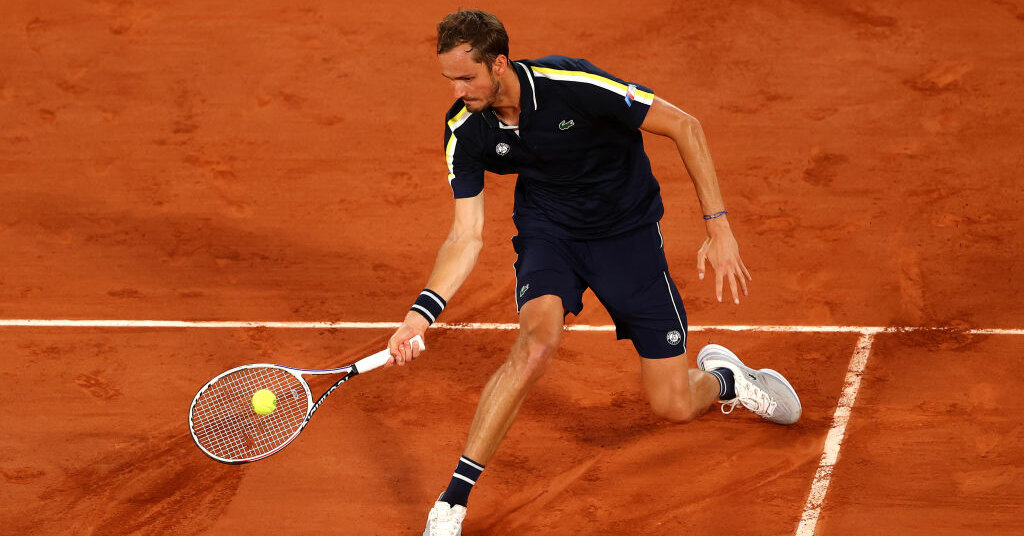
Clay is certainly not Daniil Medvedev’s favorite surface, and he’ll happily tell you so. Despite winning the Masters 1000 in Rome this year, Medvedev’s preferred surface is hard. He’s won his only Grand Slam title on the hard courts of US Open in 2021, made the finals in New York in 2019, as well as making the finals at the 2021 and 2022 Australian Open championships.
After making the finals of the 2023 ATP 1000 in Indian Wells, and taking home the title in Miami, Medvedev lost in the quarter finals of Monte Carlo to Holger Rune, and in the round of 16 in Madrid to Aslan Karatsev. Before going on to win the title in Rome, he stated that he wanted to focus on more spin and better sliding on clay.
Without watching the matches, it is impossible to judge whether Medvedev looked more comfortable sliding. I did, however, wanted to check whether there was any significant difference in the spin rates of Medvedev’s groundstrokes on the hard courts as opposed to the clay courts.
In order to do that, I looked at Medvedev’s forehand and backhand spin rates in Indian Wells and Miami this year (hard court events), and compared them to the spin rates of his groundstrokes from Monte Carlo, Madrid, and Rome (clay court events). I ended up having 10 data points for the hard courts, and 12 data points for the clay courts. To test for statistical significance, I used the unpaired t test for both the forehands and backhands, with a 95% confidence interval.
Forehands
| FH Hard Courts | FH Clay Courts | |
| Mean | 2,361.60 rpm | 2,297.92 rpm |
| St. Deviation | 98.20 rpm | 161.47 rpm |
| Sample Size | 10 | 12 |
| p-value | 0.2894 |
On the forehand side, there was no significant difference in the spin rates of that stroke on the hard courts and the clays. Overall, Medvedev’s forehand was the “spinniest” during his R32 match against Ilya Ivashka in the R32 match in Indian Wells, where it averaged 2,511 rpm. On the other hand, it was the “flattest” in his R32 match on the clay courts of Madrid against Alexander Shevchenko, with a 1,992 rpm average.
Backhands
| BH Hard Courts | BH Clay Courts | |
| Mean | 1,486.10 rpm | 1,387.25 rpm |
| St. Deviation | 107.15 rpm | 77.21 rpm |
| Sample Size | 10 | 12 |
| p-value | 0.0207 |
On the backhand side, there is a statistically significant difference between the two data sets, but it is in the opposite direction that Medvedev intended. In these particular samples, his backhand ended up being flatter on the clay courts than on the hards.
Medvedev is not known for using a lot of slice backhands at all, so I doubt that the difference in spin rates on the backhand side would be due to him hitting more slices on the hards or the clays. Adding more spin to a stroke would usually involve a change to the grip or the racket path of a stroke (or both). Backhand is arguably one of Medvedev’s biggest weapons, and maybe he wasn’t comfortable changing any of those variables to generate more spin.
It’s hard to say whether Medvedev’s flat backhand is one of the reasons for his relative clay court struggles. He hits one of the flattest backhands on the tour, and on the hard courts his stroke will stay low after the bounce, making an aggressive response from the opponent challenging. On clay courts however, the backhand will bounce a little higher, closer to the preferred strike zone of the opponent around his waist, making it easier to attack. In the end, regardless how Medvedev planned on adding more spin to his groundstrokes, his strategy didn’t work this year. With the grass court and hard court swings yet to come, Medvedev can at least look forward to his favorite part of the year.

 Michal's Musings
Wonderful insight. Would enjoy seeing more posts from you.
LikeLike
Hey, it’d be cool if you can tell me where you obtain these groundstroke data from! I need Nadal-specific forehand data for a thesis I am working on. Thanks!
LikeLike
Hi Chris – I don’t think the ATP makes that data easily accessible anymore. When you went on the ATP website, and clicked on a match result, usually there would be two options: Match Stats (still available) with some of the basic statistics like aces, rally lengths, serve points won etc; and then there would be an option called “Second Screen,” where you could dive deeper into the individual strokes. And it would have things like RPM of the groundstrokes. The closest you can get now, is go into a match, Match Stats, click on “Courtvision” and it lets you see the speeds and RPMS of winners, errors, some select shots of a match. Hope this helps.
LikeLike